
Minnesota Motorcycle Accident Claims: Protect Your Case
If you were injured in a Minnesota motorcycle crash, early action can safeguard your health, evidence, and insurance rights. Minnesota’s no-fault framework does not automatically extend PIP benefits to motorcyclists, so fault-based claims and UM/UIM coverage often matter most. Document the scene, get medical care, and talk with a lawyer before giving recorded statements or signing broad medical authorizations.
Contact us for a free, no-obligation consultation.
Why motorcycle claims are different in Minnesota
Minnesota is a no-fault insurance state, but motorcycle claims operate differently than typical passenger-vehicle claims. Under Minnesota’s No-Fault Automobile Insurance Act, the statutory definition of “motor vehicle” treats motorcycles differently, and basic economic loss (PIP) benefits are not automatically available to riders the way they are to automobile occupants unless optional coverage applies. See Minn. Stat. § 65B.43. As a result, motorcycle injury claims frequently proceed on a fault basis and may also involve uninsured/underinsured motorist (UM/UIM) coverage. See Minn. Stat. § 65B.49.
Immediate steps after a crash
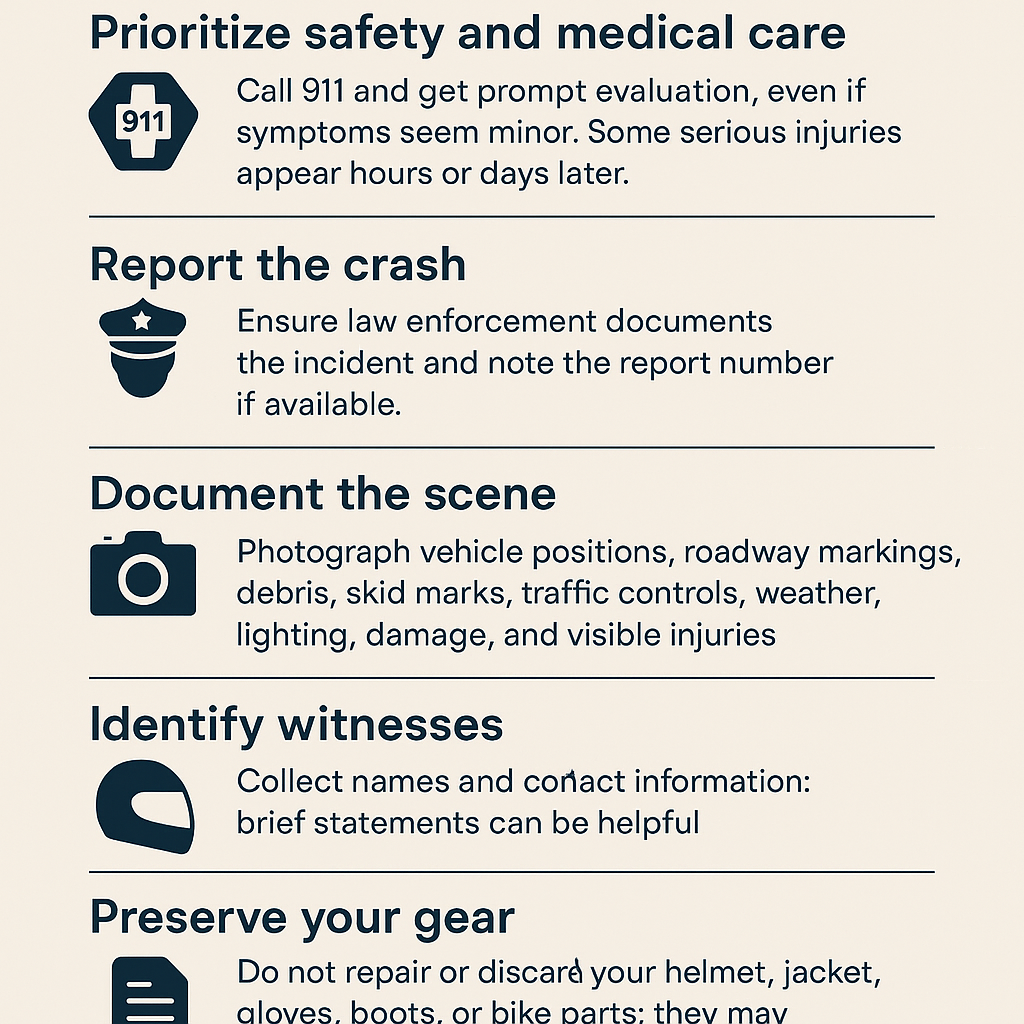
- Prioritize safety and medical care. Call 911 and get prompt evaluation, even if symptoms seem minor. Some serious injuries appear hours or days later.
- Report the crash. Ensure law enforcement documents the incident and note the report number if available.
- Document the scene. Photograph vehicle positions, roadway markings, debris, skid marks, traffic controls, weather, lighting, damage, and visible injuries.
- Identify witnesses. Collect names and contact information; brief statements can be helpful.
- Preserve your gear. Do not repair or discard your helmet, jacket, gloves, boots, or bike parts; they may be important evidence.
- Notify insurers—carefully. Promptly report the crash to your insurer. You may decline a recorded statement to the other driver’s insurer until you obtain legal advice.
Key insurance coverages that may apply
- Liability coverage (at-fault driver): Often the primary source for injury damages in a fault-based claim.
- Uninsured/Underinsured Motorist (UM/UIM): May provide compensation if the at-fault driver lacks adequate insurance. See Minn. Stat. § 65B.49.
- Medical Payments (MedPay): Optional coverage that can help with initial medical bills, depending on your policy.
- Collision/Comprehensive: For damage to your motorcycle.
- Health insurance: Often pays medical expenses when PIP is unavailable or insufficient—review coordination-of-benefits terms.
Proving fault and damages
To succeed on a negligence claim, you must establish the other party’s fault and prove your damages. Useful evidence can include police crash reports, bodycam/dashcam footage, eyewitness statements, scene photographs, repair estimates, available EDR/telematics data, and expert opinions (e.g., visibility, speed, or human factors). For damages, compile medical records and bills, imaging, provider opinions on causation and permanency, wage records and employer verification of missed work, and a contemporaneous pain and activity journal.
Comparative fault in Minnesota
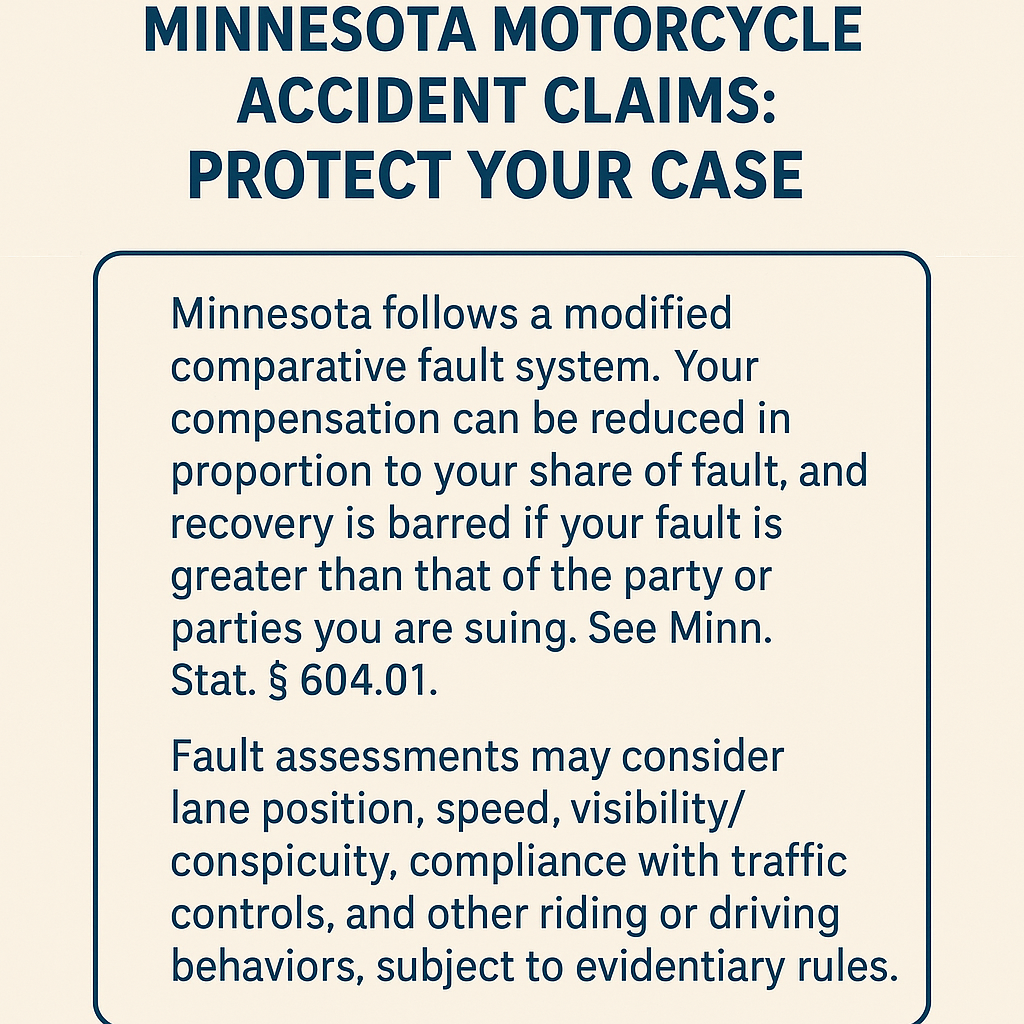
Minnesota follows a modified comparative fault system. Your compensation can be reduced in proportion to your share of fault, and recovery is barred if your fault is greater than that of the party or parties you are suing. See Minn. Stat. § 604.01. Fault assessments may consider lane position, speed, visibility/conspicuity, compliance with traffic controls, and other riding or driving behaviors, subject to evidentiary rules.
Medical treatment and documentation tips
- Follow through with recommended care and keep appointments. Gaps can undermine your claim.
- Be complete and consistent when describing symptoms and limitations.
- Save bills, receipts, mileage for medical travel, and other out-of-pocket costs.
- Keep a brief weekly journal of pain levels, sleep issues, activities you cannot perform, and mental health effects.
Quick tips for riders
- Use a single point of contact for insurers to avoid mixed messages.
- Ask providers to note work and activity restrictions in writing.
- Backup your photos and videos to cloud storage immediately.
- Politely decline to discuss prior injuries beyond what your attorney approves.
Working with insurers
Expect early contact from insurance adjusters. Be polite and brief. Do not speculate about fault or injuries. Consider declining recorded statements to the other driver’s insurer until you obtain legal advice. Before signing medical authorizations, ensure they are appropriately limited in time and scope. Avoid settling before you understand your diagnosis, treatment plan, and potential long-term effects.
When lawsuits may be necessary
Litigation may be needed if liability is disputed, injuries are serious, or settlement offers do not cover your losses. Filing suit within the applicable deadline can preserve timely claims and enables formal discovery to secure evidence such as electronic data, surveillance, and expert examinations. Settlement remains possible at any stage.
How a Minnesota motorcycle accident lawyer can help
An attorney can investigate fault, secure and preserve evidence, evaluate all applicable insurance coverages, manage communications, calculate damages, and negotiate with insurers. If necessary, they can file suit and prepare your case for trial while you focus on recovery. Speak with a Minnesota motorcycle accident attorney.
Practical timeline considerations
Deadlines for injury claims in Minnesota are governed by state statutes and can vary based on the type of claim, the parties involved, and other factors. Insurance policies can also contain prompt notice and cooperation provisions. Because timing rules can be strict and exceptions may apply, consult counsel as soon as possible to avoid jeopardizing your rights.
Crash-day checklist
- Call 911 and request police and medical response
- Photograph vehicles, roadway, traffic controls, and injuries
- Exchange information and capture license/insurance details
- Collect witness names and numbers
- Preserve your helmet and riding gear
- Report the claim to your insurer
- Schedule a prompt medical evaluation
- Consult a lawyer before recorded statements
What to bring to your consultation
- Crash report number and any exchange forms
- Photos and videos
- Names and contact information for witnesses
- Medical records, discharge papers, and bills
- Health insurance and motorcycle insurance cards and policies
- Employment and wage information
- Your riding gear (or photos) and any damaged parts
- A timeline of events and symptom progression
FAQ
Do motorcyclists get no-fault PIP benefits in Minnesota?
Not automatically. Motorcycle PIP is different from automobile PIP and may be unavailable unless you purchased optional benefits. Review your policy and endorsements. See Minn. Stat. § 65B.43.
Should I give a recorded statement to the other driver’s insurer?
Not before speaking with a lawyer. Provide your own insurer with required notice, but consider declining recorded statements to the opposing insurer until you receive legal advice.
What if the at-fault driver is uninsured or underinsured?
Your UM/UIM coverage may apply to compensate you, subject to policy limits and conditions. See Minn. Stat. § 65B.49.
Will not wearing a helmet prevent recovery?
It does not automatically bar a claim. However, it may be argued in comparative fault or damages assessments, particularly regarding head injuries. Case-specific legal guidance is important.
How long do I have to file a claim?
Deadlines vary by claim type, parties, and other factors. Some claims have shorter notice requirements. Speak with an attorney promptly to protect your rights.
Ready to protect your claim? Contact us today for a free consultation.
Sources
- Minnesota Statutes § 65B.43 (No-Fault definitions, including treatment of motorcycles)
- Minnesota Statutes § 65B.49 (Liability, UM/UIM, and related coverages)
- Minnesota Statutes § 604.01 (Comparative fault)
Last reviewed: August 15, 2025
Disclaimer: This blog is for general information only and is not legal advice. Reading it does not create an attorney-client relationship. Legal outcomes and deadlines depend on specific facts and Minnesota law, which can change. Consult a licensed Minnesota attorney about your situation.


